Proud PINOY does not claims any credit for any articles, news and/or photos posted here. All visual content is copyright to its respectful owners. All info's are not accurate and may contains errors. If you are the owner to any photos or articles, and does not want us to post it here, please contact us by e-mail

Saturday, January 19, 2013

Fil-Am IT expert organizing an ‘angel network’


By: Carissa Villacorta
Philippine Daily Inquirer
Bohol-born Winston Darillo left for the United States over two decades ago, armed only with a diploma in Industrial and Mechanical Engineering from De La Salle University in Manila. Apart from following his then girlfriend (now his wife), he had his eye on Silicon Valley.
“It ‘only’ takes a La Sallian education to make it in America,” quips Damarillo, who competed with candidates from Harvard, M.I.T. and Stanford to become one of California’s most successful young information technology (IT) entrepreneurs.
“That, plus guts, courage and determination,” adds Damarillo, who recalls spending time as a “couch surfer” at his uncle’s home in California before landing a job at Intel with over twenty applications.
He rose to become a star employee then took off to set up his own company. At 35, he picked up a multimillion dollar check from selling his first company, Gluecode, an open source application infrastructure software company, to IBM in 2005.
“I think it’s persistence, it’s not giving up. The Filipino brain is no different from the American brain. What can be changed from a Filipino standpoint is our confidence and our drive. And our believing that we can achieve it,” he says.
Instead of resting on his laurels, Damarillo continued to create and build innovative businesses that predict emerging trends in technology. He started two more software companies, Logicblaze, acquired by Iona Technologies in 2007, and Webtide, bought by Intalio, in 2009.

Coming home
In 2001, Damarillo returned and cofounded Exist Global Inc., now one of the Philippine’s leading software development and technology companies, with offices in Cebu and Manila. It provides Open Source, Java, Ruby on Rails, web and mobile application development services. Aside from its local bases, Exist also has offices in Japan, Indonesia, and Singapore. Currently, the company has over 100 people in its Manila headquarters and over 50 in Cebu.
Among its many successes, Exist built one of the best cellular phone applications for GSM in Barcelona, Spain.
Up in the cloud
In 2007, years before cloud computing was the buzz of the industry, Damarillo founded Morphlabs, Inc. now considered a global leader in digital cloud infrastructure development.
In October 2012, Dell, Inc., the third largest global PC provider, announced its partnership with Morphlabs through its new product, mCloud Helix, described as the most price-performant private cloud in the market today.
Morphlabs started in Cebu in 2007, and five years later, set up  operations in Manila, Indonesia, Japan, and Singapore, with its headquarters in California.
For those not yet familiar, Damarillo explains that the most common understanding that we have of cloud computing right now are things like Facebook and Twitter and Google—things that you use everyday. “It’s like electricity.  You don’t know where it comes from, you just use it. It’s from the cloud. The infrastructure for cloud computing is what we do at Morphlabs.”
Providers like Morphlabs serve as an active cloud enabler. Such trends put the company and its founder at the forefront of the industry.

Young global leader
In 2010, from a pool of about 5,000 candidates, Filipino technopreneur Damarillo was named among the Young Global Leaders by the World  Economic Forum.
Both Exist and Morphlabs have won the prestigious Red Herring Asia, which recognizes the  region’s top software companies.  According to their website, Red Herring “analyzes hundreds of cutting edge companies and technologies and select those who are positioned to grow at an explosive rate.” To date, only these two companies have been recognized from the Philippines.
Journeys like Damarillo’s and stories like Exist’s and Morphlabs’ are proof that Filipino engineering can become world-class.
Damarillo, who sits on the board of the Philippine Development Foundation (PhilDev), joined the recently concluded Hack2Hatch ‘from Hacker to Founder,” a program in Cebu that brought successful innovators and investors from Silicon Valley to meet and mentor, one-on-one, young and existing startups from the Philippines. They gave the top eight startups no-strings-attached seed money and invaluable advice.
Angel Network funds
Damarillo and PhilDev are taking it one step further by forming an “Angel Network.”
The project is a cooperative of investors who are willing to help fund Philippine-based and Fil-Am-headed start-ups. “The idea here is it’s biased towards Filipinos, because its contents should be biased towards Filipinos,” he says.
Among his backers is computer engineer Diosdado Banatao, one of the first Filipinos to hit it big in Silicon Valley.
The Philippine Angel Network Fund, Damarillo says they will ask individual investors to commit to an investment level, around $100,000. “Investors in the fund will select which companies they would like to invest in,” says Damarillo. “So you [start-ups] still have to sell yourselves to investors of the fund.”
The project has attracted government assistance. The Angel Network Fund will be taken under the wing of Department of Trade and Industry, he says.
“We need to do it fast because we are so far behind,” Damarillo says, citing that similar ‘angel funds’ all over Asia are already extending help to small businesses in their respective countries.
“I believe that Philippine education and innovation makes the Philippine software industry equipped and ready for leadership in the Association of Southeast Asian Nations and the global markets. I’m very optimistic about the Filipino capability. We just need to synergize and become one.”
Find your passion
Damarillo’s advice to aspiring technoprenuers: “If there is one thing to do, it is to do introspective soul searching to find your passion. When you wake up in the morning, what makes you excited? To me that’s rapidly changing all the time ‘cause today I’m getting excited about cloud computing, tomorrow, energy. But that excitement has to be there. When you have that excitement first everyday, everything follows. When you have passion for something, whatever is missing in knowledge you’ll acquire. Whatever is missing in capital, you will seek out. Whatever is missing in people and team, you will be the best sales person of your idea. But it starts with passion and that’s what I’m looking for in Hack2Hatch and the Angel Network. I’m looking for people who believe in what they are trying to do and who will commit to whatever it takes to be successful. And you can detect that very quickly so, that’s what I advise people. Find your passion.”

PH nurses to the rescue


By: Eunice Barbara C. Novio 

DUBAI, UAE—A man dials 999. Hazel Margarita Parado takes the call.  Geoffrey Panganiban, part of a three-man ambulance team, prepares for dispatch. It is an emergency hotline in Dubai.
Hazel Margarita and Geoffrey are Filipino nurses, a growing presence in the government-backed Dubai Corporation for Ambulances (DCAS), one of the most modern ambulance services in the world.
“As an ambulance nurse, I have to attend to different kinds of emergencies. Most patients are those involved in road accidents and work or house emergencies. Most common cases are trauma, cardiac case, and diabetic emergencies,” explains Geoffrey.
Technically, they are pre-hospital ambulance nurses or paramedics. They are the first to respond and bring the victim to the hospital for further treatment.
Another overseas Filipino, Robert Fortinez of North Cotabato, has been working for 14 years as an emergency medical technician.
“We often work with the police and firefighters, since some emergency cases are accidents,” he says.
In the early ’80s, ambulance service in Dubai was under the police and the department of health services. In 2006 the government merged and unified all the ambulance services. In 2010, the Ruler of Dubai
established the Dubai Corporation for Ambulances (DCAS), which now has more than 60 ambulance stations working 24/7.
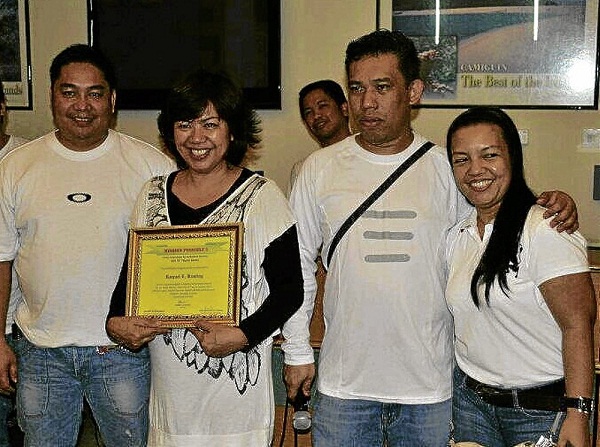
BADGE OF SERVICE From left: Robert, a staffer of the Philippine Overseas Labor Office with Hazel Margarita Parado and Geoffrey during ceremonies last October recognizing outstanding OFWs
Aside from giving first aid and transporting victims to hospitals, DCAS also has big mobile intensive care ambulances.
What they call “Mama units” are ambulances exclusively for emergencies involving a female patients, mostly obstetric or childbirth emergencies.
World’s biggest ambulance
Dubai, by the way, holds the Guinness record for having the largest ambulance in the world. The rich kingdom acquired in 2009 three Mercedes Benz Citaro bus-clinics comprising an operating theater, three intensive care units and eight immediate care units. Two of the clinic-
buses have a length of 12 meters while another is 18 meters long. They are available for rapid medical assistance, particularly in the event of major emergencies with a large number of injury victims. The DCAS has also licensed private air ambulances, also equipped with intensive care units.
Joining DCAS
Geoffrey, from Abra de Ilog, Occidental Mindoro, has been working with the ambulance service for five years now. In the Philippines, he had gained experience in rescue operations as a Red Cross nurse and a member of the UP Mountaineering Society.
“My work is very similar to paramedics in the TV series 911. I am under the ambulance operation department of DCAS. My office is my ambulance rig. An ambulance in Dubai is manned by two nurses and a driver,” explains Geoffrey.
He says weather conditions in the Middle East also make their work challenging.
“Can you imagine responding to a car accident under direct sun of almost 50 degrees Celsius? I have to carry a 20-kilo kit, kneel on concrete hot pavements and lift patients that are sometimes double my weight,” says Geoffrey.
Challenges at work
Hazel Margarita, who takes the calls, has been working six years as an emergency medical dispatcher. She immediately guides callers on first aid steps while locating and dispatching the nearest available ambulance.
Margarita’s job requires her to have knowledge of the Arabic language as well as familiarity with the streets and landmarks in Dubai to be able to guide the ambulances  to the caller’s location.
A nurse needs to be able to imagine or picture the situation and guide the caller through initial first aid steps while he or she waits for the ambulance.
Confidence, patience and better judgment are needed in this kind of work, sums up Hazel Margarita.
Staying cool
The Filipino sense of humor and natural adaptation to any environment make them stand out among others, believes Hazel Margarita.
“We are hard working. In spite of the difficulties of any emergency situations, we show coolness and manage to smile and laugh,” she asserts.
Geoffrey, for one, is more than just an ambulance nurse. He has organized a mission for distressed OFWs housed at the Philippine labor office in Dubai.  The project is implemented in coordination with Migrante Dubai, a private organization for the protection of Filipino migrants.
Geoffrey has also initiated humanitarian activities like the packing of goods for relief in troubled areas in Gaza and Pakistan. He was endorsed by the operations manager of DCAS to the Dubai Red Crescent where he has become one of its few Filipino volunteers.
“Wherever we are, we love what we are doing. We are always motivated, not only by financial gain, but even more by our commitment to service to others,” adds Robert.

Friday, January 18, 2013

Cartoon Network’s Johnny Bravo creator is Proudly Filipino


Van Partible definitely draws from his experiences, and that includes his being Filipino.
The Filipino-American animator (born Efrem Giovanni Bravo Partible) is the creator of the Cartoon Network original animated series Johnny Bravo, which is about a muscle-flexing and karate-chopping Mama’s boy, who’s convinced he’s God’s gift to women, dishing out disastrous pick-up lines like “Enough about you, let’s talk about me, Johnny Bravo.”
The 40-year-old artist never thought that the title character of the series, described by fans and critics alike as clever, funny and totally irreverent, would become an iconic cartoon. “The character was based a lot on my love for Elvis. I also make a character based on all the things that I know and love, so he had moves like Michael Jackson. His cool came from Henry Winkler’s character from the American sitcom Happy Days. His poses came a lot from my (former) roommate, who was pretty much into his body. And I also had a lot of friends who got women all the time, and I wasn’t so much of a ladies’ man, so I thought, it was fun to make fun of them,” Van told The STAR in a phone interview.
Why the character has had connected with viewers, according to Van, is because “there’s a part of Johnny Bravo in every guy — a part that wants attention. He’s just looking for someone who notices him and who thinks he’s cool.”
The phone interview with Van was arranged in relation to the forthcoming premiere of Johnny Bravo Goes To Bollywood, wherein Johnny, with his beefcake swagger, pompadour ‘do and all, pursues his big Bollywood dreams, and along the way, maybe — just maybe — finally gets lucky in love. This comeback special of Johnny Bravo, which ended its original run in 2007, is Cartoon Network’s first full-length made-for-TV musical to be aired on Nov. 27, 4 p.m.
Johnny Bravo was Van’s senior year thesis project as a studio arts student at the Loyola Marymount College in California. A seven-minute short originally titled Mess O’ Blues, he sold it straight out of college when Cartoon Network was looking for shorts to debut in the animation showcase World Premiere Toons in 1995. The character became an instant hit that Cartoon Network commissioned a first season for Johnny Bravo which commenced in 1997.
The series enjoyed four more seasons, and while there were inherently, albeit subtle, Filipino attributes in the Johnny Bravo character (i.e. him being close to his “momma”), Van said that it was in the fifth season that he consciously added some Filipino flavor into it.
“I wasn’t much in touch with my Filipino roots when I first developed Johnny Bravo,” Van admitted.
That changed after watching the movie The Debut, directed by Fil-Am filmmaker Gene Cajayon about a talented high school senior who enrolls in an elite arts institute to realize his dreams of becoming an artist, but in the process, struggles for acceptance in America and thereby, rejecting his heritage.
Because the story struck close to home, Van said, “It really got me thinking about my roots. So on the fifth season of Johnny Bravo, I thought I wanna hire more Filipinos. I hired voice actresses that are Filipinos like Tia Carere, Lea Salonga and Dante Basco. There’s also one episode that had a caricature of me, saying some things in Tagalog.”
It was a long-standing family affair with comic books that paved the way for a career in the animation arts. “We collected comic books, my brothers and I. My dad collected comic books when he was in the Philippines, so we pretty much carried on the tradition to the point that by the time I graduated from high school we had about 15,000 to 20,000 comic books. I started out just copying the characters from comic books. It was a natural introduction to all kinds of media from movies to TV,” said Van, whose other brothers are also part of the US film industry but doing live action work.Van’s father is a certified public accountant, who still runs his own accounting firm in the US, while his mom used to work for the state. They immigrated to the US in the early ’70s. “How Filipino am I? I’m pretty Filipino,” Van, who’s married and a father of two, said. “I was born in Manila and we still have lots of relatives in Bagnotan in La Union. My father moved to the States 18 months after I was born because he got a job. He brought us to the US nine months after,” said Van.
Was it hard breaking into the industry as an Asian, and specifically as a Filipino? “I never gave that a lot of thought. At the beginning of (Johnny Bravo), I was so far removed from considering myself to be Filipino; I was just trying to get into the industry based on talent,” Van shared. “I felt like, okay, either I’m going to get in or not.”
He said that whatever struggles he had to hurdle were not due to being Filipino but due to a “lack of experience or lack of talent.” He cited the design problems that cropped up during Johnny Bravo’s first season because “my design vocabulary wasn’t the greatest.”
“Those were setbacks, but I just got better with what I did (because) I always challenge myself to do better, and that’s pretty much what I keep on doing,” he said.
Van is also aware that there’s a budding animation industry in the Philippines and he’s willing to lend his expert advice and help if sought out. “I knew that there’s Phil Cartoons, but I’ve never really talked to people there in the Philippines. I’m more than willing to help, and it just depends on what capacity and where I can help.”
He, nevertheless, gave this advice to aspiring animators. “In order to break into the animation industry, you really have to have a good portfolio. That’s the first step: It’s knowing your craft, and then, being a person other people would want to work with. That’s what I feel: Many percent of the jobs out you can get through people that you know.
“You can get your foot in the door if you have a really good portfolio but staying long in the industry is by who you know, and how you get on to the projects. Reliability is key. If you have talent and you’re reliable, you’re someone people would want to hire,” he ended.
(Story courtesy of Nathalie Tomada of the Philippine Star)

Proudly Pinoy-made train to run in Taguig from next year


The country’s first locally developed train will start running next year.
Science Secretary Mario Montejo said the automated guideway transit (AGT) would operate in Bicutan, Taguig, as a mass-transit system.
A prototype of the AGT had a test run on the University of the Philippines campus at Diliman in Quezon City on Dec. 14.
In a recent talk with reporters, Montejo said the AGT service would be a joint venture between the Department of Science and Technology (DOST) and the city government of Taguig.
The DOST will build a 500-meter elevated track in Bicutan and the Taguig government will add a 2-kilometer stretch to it, Montejo said.
The train will run from the crossing rotunda near the DOST compound in Bicutan and over Circumferential Road-6 (C-6) along Laguna de Bay.
Montejo said the DOST had allocated P40 million for the construction of the 500-m section of the AGT track.
The amount does not include the cost of two coaches, which Montejo said would be as spacious as those used on the Light Rail Transit (LRT) 2 line.
Developed by DOST engineers in cooperation with UP experts, the electric train will undergo a series of test runs until June next year in preparation for actual operations.
The train runs on 465-m-long elevated track on the UP campus.
According to the DOST, the goal of the project is to have a fully automated, emission-free transportation system capable of ferrying up to 60 passengers per trip.
Montejo said the fact that the AGT is running is already an accomplishment for its designers and engineers.
The entire system was designed and manufactured by Filipinos, using locally available materials.
Montejo said the prototype cost about P55 million. The track cost about P22 million and the two locally built coaches, P9 million. Research and development cost about P24 million.
Still, the AGT cost only about a fifth of the cost of acquiring a similar foreign-made train, according to the DOST.
“Why is it cheaper? It’s like using generic against branded,” Montejo said.
He said several parties—including at least one local government, two big industry players and one private developer—have shown interest in the AGT.
“We just developed it and then others should pick it up,” he said.
But more than creating a Philippine-made train, the greater goal of the project is to enable Filipino engineers to develop the expertise to design and operate a mass transit system, Montejo said.

Filipino peacekeeper cited by the United Nations for bravery


For his bravery when he secured and kept 14 Austrian passengers out of danger in Syria last November, a Filipino peacekeeper received the Peacekeeper of the Month Award.
Tech. Sgt. Herman Galiza, a member of the 6th Philippine contingent to Golan Heights, received the award during the command briefing at the United Nations Disengagement Observer Force (UNDOF) headquarters at Camp Fauoar in Syria last Jan. 9.
Lt. Col. Nolie Anquillano, commanding officer of the Philippine contingent, said UNDOF chief Maj. Gen. Iqbal Singh Singha conferred the award on Galiza, bus driver for the Austrian and Croatian contingents rotation convoy from Camp Faouar to Damascus International Airport last Nov. 28.
The convoy, consisting of 25 vehicles, came under heavy fire by anti-government forces while on its way to the airport. Galiza accelerated his vehicle to secure and keep his 14 Austrian passengers safe and out of danger.
The Peacekeeper of the Month Award is granted to deserving soldiers in UNDOF for exemplary performance of duty and outstanding contribution to peacekeeping.
“This award will reflect on how the 6th Philippine Contingent to Golan Heights performed well in its mandated tasks and mission. Likewise, this will boost the morale of the officers, menand women of the Philippine battalion,” Anquillano said.

Tuesday, January 15, 2013

Search on for Pinoy barista to compete in world championship

The Filipino barista who will win in the first Philippine National Barista Championship in February will represent the country in the World Barista Championship in May 23 to 26 this year in Melbourne, Australia.

The winner will get a P10,000 cash prize, a one-year coffee education scholarship worth
P30,000, and an all-expenses-paid round-trip airfare and accommodation to the coffee-
making competition in Australia, where he or she goes head to head with more than 50 other
national representatives.

The search for the country’s official representative will happen on February 1 and 2, 2013, at the Megatrade Conference Center in SM Megamall, Mandaluyong City, in an event organized by the Association of Filipino Baristas, Inc., and Espresso World.

Only one contestant per coffee house can participate during the preliminary round, with the top six advancing to the finals.

Now on its 12th year, the World Barista Championship is considered the most prestigious coffee-making competition in the world and has even been called the “Olympics of Coffee.”

Competing in three elimination rounds, contestants have to create 12 coffee beverages,
consisting of four espressos, four cappuccinos, and four signature drinks, within 15 minutes.

They earn points not only for the taste, visual presentation, and functionality of their drinks, but also for keeping their working areas clean and maintaining good hygiene.

Cynthia Ludviksen, managing director of World Coffee Events, which licenses the Philippine
National Barista Competition, said it’s good to see baristas get “much-deserved recognition at all corners of the world.”

In a press release, Ludviksen said, “The Philippine National Barista Championship will certainly elevate the role of Filipino baristas. It’s very encouraging to watch them share their expertise, passion, and knowledge of specialty coffee.”

Although the Philippines has not had an official representative to the World Barista
Championship in the last 12 years, numerous Filipino baristas have competed and won in
several international contests.

One of them is UAE-based Pinoy barista Gerald Delos Reyes, who emerged the Regional
Barista of the Year for the Middle East and North African region in October 2012.

A barista at the Dubai Airport Costa Coffee branch, Delos Reyes impressed judges with his
Mocha Flora— a lavender- and rose-infused mocha drink—and bested eight other rivals from Oman, Bahrain, Qatar, Saudi Arabia, Lebanon, Egypt, and Kuwait. - VVP, GMA News

Bataan businesswoman receives papal award

A 62-year old businesswoman from Bataan province received from Pope Benedict XVI last weekend the Holy Cross Pro-Ecclesia et Pontifice medal.

Milagros Faith Aquende Banzon was handed the gold medal by Bishop Ruperto Santos during a Mass on January 12 at the St. Joseph Cathedral in Balanga City.

“This is the highest award given by the Pope to a member of the laity for their contribution to the Catholic Church,” Santos said, according to the Catholic Bishops' Conference of the Philippines (CBCP) news site.

Mrs. Banzon became the first papal awardee in the diocese in 15 years after her husband Oscar Banzon received the same honor in 1997.

The CBCP also said Banzon has been active in various activities organized by the Diocese of Balanga.

The couple owns different businesses including hotels, restaurants, resorts and subdivisions in the province.

“All the achievements of our family came through God’s blessings,” she said as she asked herchildren to follow what they are doing for the Church.

Instituted by Pope Leo XIII in 1888, the medal is bestowed to lay people and clergy who have given zealous and outstanding service to the Church through the recommendation of the local bishop, the CBCP said. - VVP, GMA News